Quick answer: Your dryer could be overheating due to a blocked dryer vent, a faulty heating element, or a faulty thermostat. It’s also possible for the dryer to overheat if it is kept in a tight and restricted area. Each of these problems has an easy solution, which we will discuss in detail in this guide.
Introduction
Your dryer generates heat to dry your clothes. What happens when something goes south with this process, and the dryer ends up generating too much heat?
It is a safety hazard. An overheating dryer can cause house fires and damage the areas/appliances around it. It can cause burn injuries to the person operating it. In some cases, the dryer can also release carbon monoxide into the living space, which is a deadly, odorless gas.
You want to make sure that your dryer never overheats. But if it’s already doing that, you should learn about the causes so that you can take the right measures to fix the problem.
Let’s get into that.
Reason # 1 for an Overheating Dryer: Blocked Air Vent
Your dryer needs a vent to release the heat that it generates for drying your clothes. If the outlet is blocked, the heat has no place to go, and hence the dryer overheats.
A blocked air vent is the most probable cause of an overheating dryer. It is also the easiest to fix.
Usually, there is a metallic pipe attached to the back of the dryer that connects to an exhaust vent leading outside. Here is a rough representation of what it looks like:
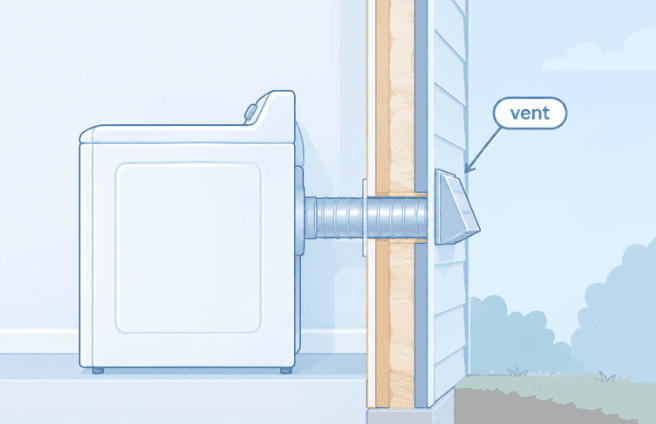
Of course, the placement and orientation of the pipe are different in reality, but you get the picture.
Now, there are a number of things that can cause issues here.
- The exhaust outlet on the outside can get blocked, either by an object or by debris that happens to fly by.
- The pipe can get crimped or twisted, leaving no room for the hot air to go out.
- Debris or lint can come inside the pipe from the dryer’s end, blocking the pathway.
What is the Solution for a Blocked Air Vent?
Here are some ways to fix a blocked air vent that is causing your dryer to overheat:
- Check the outdoor outlet. Inspect the hood and see if there are any obstructions restricting the airflow. Make sure that the dryer is off. Then, clean the whole thing out and make sure there are no obstructions.
- Disconnect the pipe and inspect it for lint and debris. Clean it out and reconnect it.
- Check the pipe and see if it is getting twisted or crimped at any point. If it is, straighten it out and make sure that the pipe curves smoothly at any point that it has to turn.
When taking any of these actions, turn the dryer off to avoid getting burned.
If cleaning the vent doesn’t resolve the problem and your dryer continues to overheat, you may need a professional dryer repair technician to inspect the appliance.
Reason # 2 for an Overheating Dryer: Faulty Heating Element
The heating element in your dryer is a coil that generates heat from electricity. This coil has to start up and stop at set intervals, as instructed by the thermostat.
If there is something wrong with the heating element, due to which it can’t understand when to start and when to stop, it can keep on going until the dryer starts to overheat. If your heating element is faulty, learn whether replacing it is worth the cost before deciding on a repair.
This cause is not as common as the one mentioned above, but it is still something that you should consider.
Where is the Heating Element Found in a Dryer?
The heating element is located on the back of the dryer inside a metal housing unit.
I found this image on Facebook in a community where someone was asking a question about how red the coils should turn. This image is a good representation of what the heating element looks like and where you can find it.
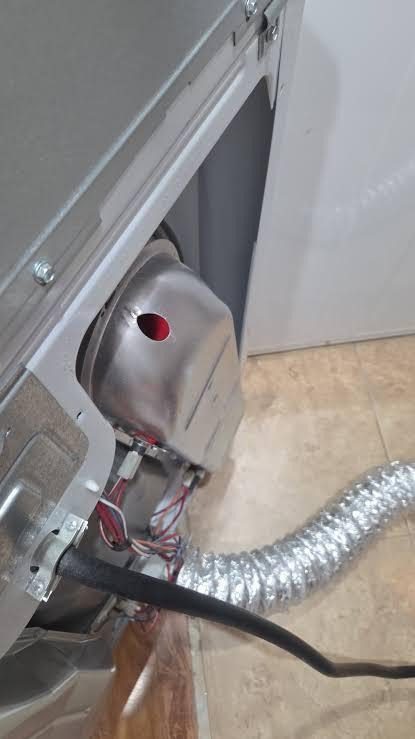
Image source: Facebook
How Do You Know the Heating Element is the Culprit?
First, to make sure the vent is not the issue, make sure that it is clean and clear, and there is no blockage.
If that doesn’t solve the problem, take a look at the heating element. The coils should glow a little, as shown in the image above.
However, if they’re bright orange, and if the casing is also changing color due to the excessive heat, and if the whole area around the back of the dryer is getting warm, then it means the heating element is the culprit.
At this point, you should call a professional.
How to Fix a Faulty Heating Element
This problem does not have a DIY fix. You should get a professional to look at the heating element. They’ll guide you from there. Usually, it’s not an expensive fix.
Reason # 3 for an Overheating Dryer: Faulty Thermostat
You know how we mentioned that a faulty heating element can cause overheating when it doesn’t know when to stop.
The thermostat is the part responsible for telling the heating element when it has to stop and start up. If something goes wrong with the thermostat, you can end up with the same problem.
A professional can diagnose whether the issue lies with the thermostat or the heating element. There isn’t much that you can do on your own. It’s handy to know the reason so that you don’t get spun around by the repairmen, but as far as fixing the problem goes, it’s out of your hands.
What are Some Other Causes for an Overheating Dryer?
Here are some other reasons why a dryer can overheat, apart from the ones that we’ve mentioned above:
- Lint buildup inside the machine itself: Lint collects around the drum, inside the blower housing, and near the heating element compartment. It gets trapped there and holds heat in places it shouldn’t.
- A bad timer or control board: Electrical faults in these parts can keep the heating element powered longer than it should be.
- Drum seals or felt worn out: Worn seals let hot air escape into areas it shouldn’t reach. This can trigger the safety thermostat or scorch nearby components.
- Overloading the dryer: Too many clothes in the drum restrict airflow. Heat can’t escape efficiently as a result.
- Bad placement: Pushing the dryer too close to a wall or tucking it into a tight closet blocks airflow around the back panel. The dryer can’t release heat properly, even though the machine itself works fine. This is an easy cause to overlook.
Here is an overview of the solutions for these causes:
| Cause | Solution |
| Lint buildup inside the machine itself | Open up the dryer and clean out the drum area, blower housing, and heating element compartment. Do this at least once a year, or more often with heavy use. |
| A bad timer or control board | Have a technician test the timer and control board. Replace whichever part is failing to keep the heating element under control. |
| Drum seals or felt worn out | Replace the worn seals or felt strips around the drum. This keeps hot air contained where it belongs. |
| Overloading the dryer | Reduce load size so air can circulate freely through the drum. Split large loads into smaller ones. |
| Bad placement | Move the dryer so there’s proper clearance behind and around it. Most manufacturers recommend at least a few inches of space for airflow. |
Conclusion
If your dryer is overheating, you shouldn’t ignore it. Even if the overheating is minor at present, it can evolve into a safety hazard and an expensive problem to fix later on.
If you’re in the Hallandale Beach area in Florida, you can hire MTV Appliance Repair Service to fix your dryer. We’re a trusted name, and we’ll get your problem fixed in a jiffy.